
OpenAI has recently released more than 700 mathematics results proved by their latest model, bringing human mathematics as we know it to an end. Much ink has been spilled about the impacts of this. Beyond the sheer number of results, what is almost as interesting is what these results *don’t* cover.
The internet commentariat quickly noticed that nothing touched modern cryptography, and some suspected this was no accident:


But let’s take a look at the data: is cryptography actually underrepresented, and which fields are conspicuously missing from the recent OpenAI math results? This sort of question nowadays is easy to answer with a coding agent and a Semantic Scholar API key. Turns out there are other clear patterns, apart from cryptography.
Precisely, OpenAI has published very few results on statistics, ML theory, optimization, and numerical analysis. These are large parts of mathematics nowadays, making up 20% of arXiv theorems, but less than 1% of the OpenAI results!
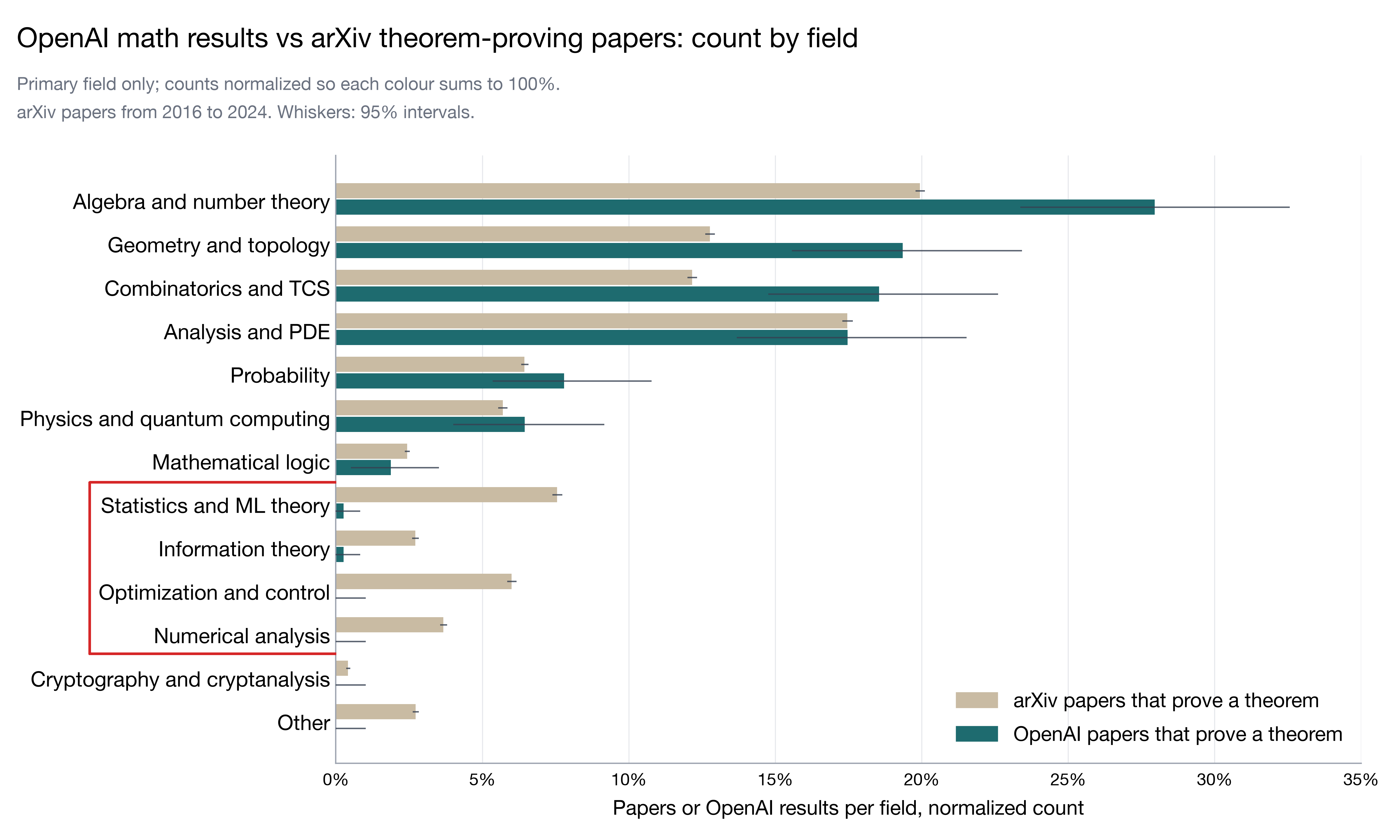
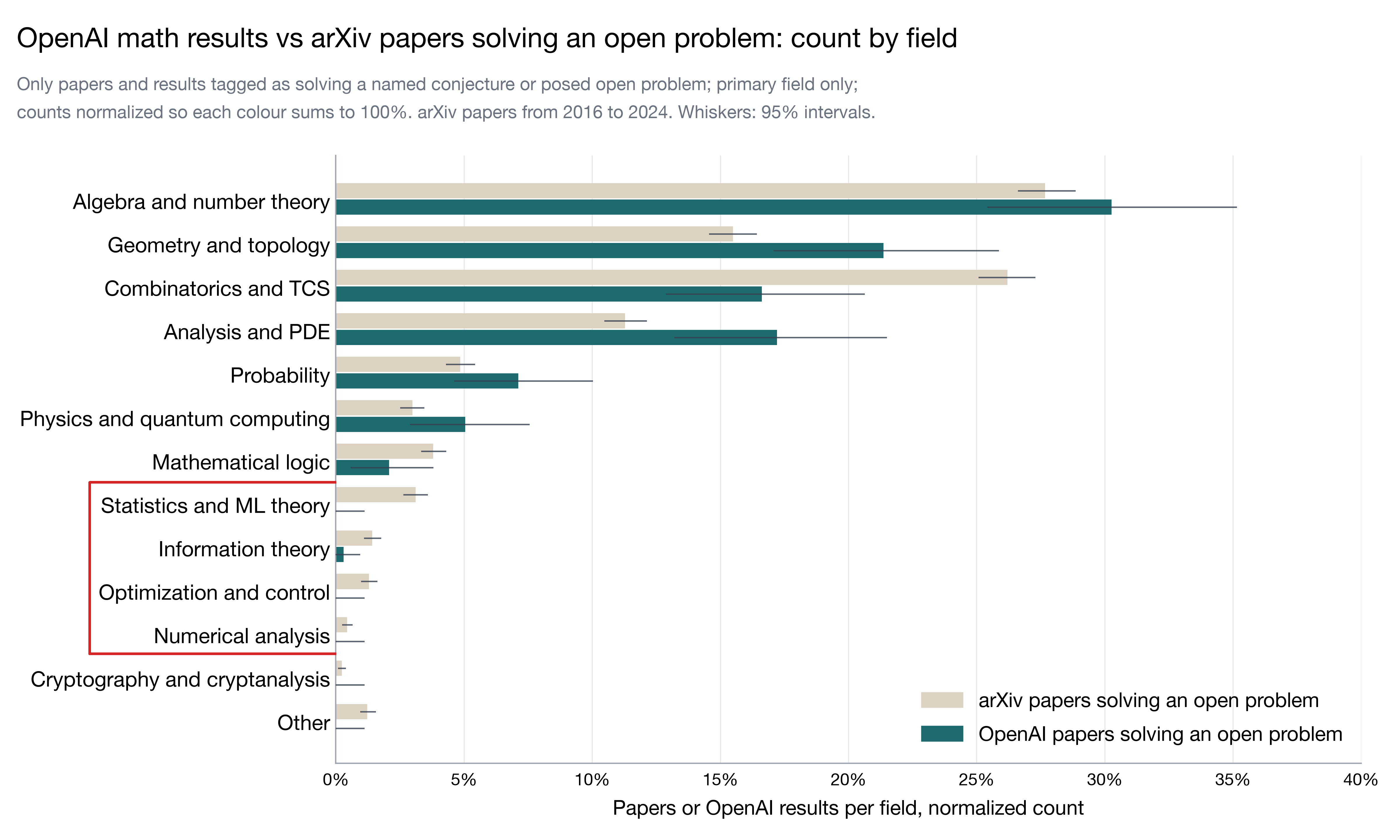
One hypothesis is that these fields simply don’t have open problems; but this is not really true. The gap reduces, but is still statistically significant, if we consider only arXiv papers that solve open problems as making up the baseline ratio.
Or could it be that the OpenAI team is just not familiar with open problems in optimization or machine learning theory? Some readers might be familiar with one of the first signs of AI being transformative in math, this tweet in 2025…


Of course, one explanation is that the portion of math that is missing is the closest to what all labs (not just OpenAI) might want to use internally; hence all labs will generally abstain from publishing, to preserve comparative advantage.
I noticed this discrepancy due to these fields being an old interest of mine. Around 2020, I stopped doing mathematics, largely due to AI. Instead of cutting it completely, I spent about a year and a half not fully letting go, trying to have it both ways. Dabbling in fields such as statistical learning theory, random neural networks, mixed integer optimization, even trying to understand properties of SGD and batch normalization… This was not entirely useless, but to be honest I haven’t used any of it in a while.
Only a single mathematical result in the OpenAI math dump would be professionally interesting to 2020-2021 me: Max-Cut cannot be approximated better than 0.878 assuming P != NP. This does not really count, as it falls out as a consequence of a complexity theory result, the excitingly named Unique Games Conjecture Theorem, that OpenAI proved in the same batch.
Back to “math might be useful for LLM training”. My belief is this:
Despite pre-2026 deep learning theory and similar fields being far too weak, asking the wrong questions, and the disconnect to frontier LLMs…
Mathematical capabilities will at some point make a comeback and feed back into LLM training.
The truth of the matter is that mathematics has shown the fastest growth in capability across ~all domains of human expertise. The moment of “math is now solved” we are in now is just a historical blip, as the true ceiling of mathematical ability extends far beyond what people can hope to understand.
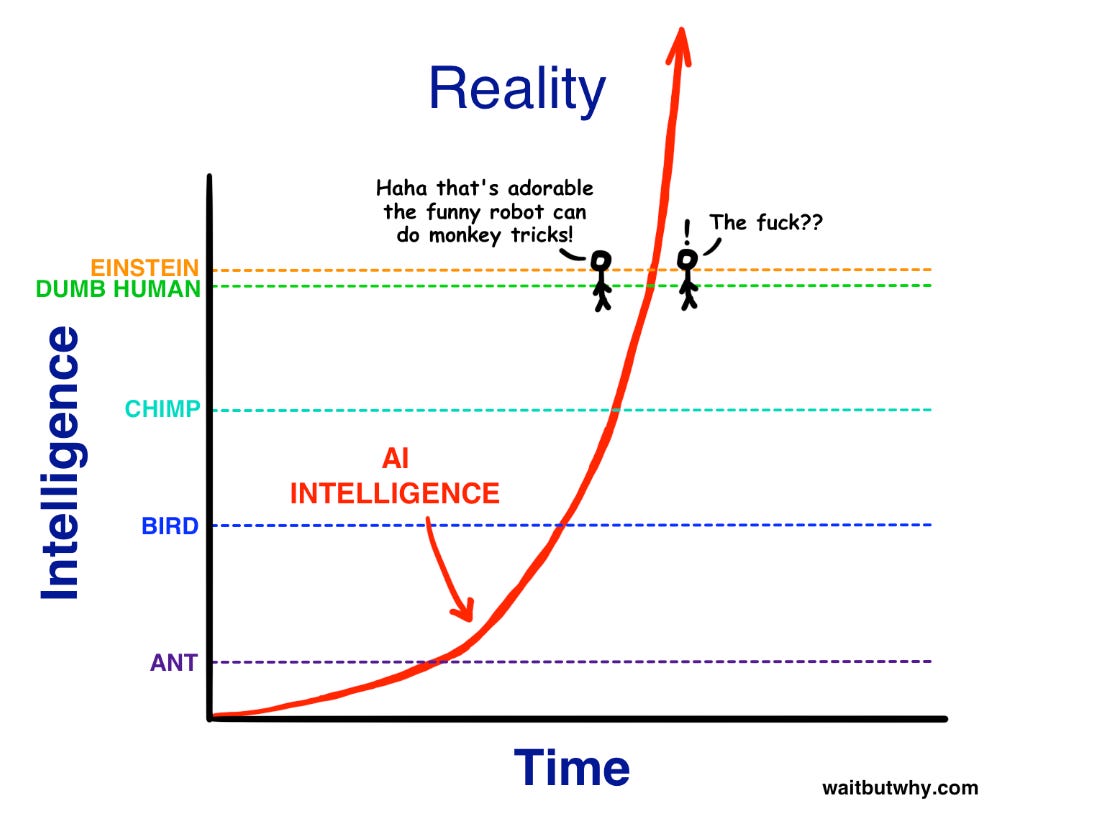
Many readers have seen this plot many times; and most have also seen counterarguments. There are bottlenecks—data availability, expensive feedback loops, OOD generalization, etc.—and if we see AIs or AI companies taking over the world, automating everything our civilization does seems like a real grind.
But note that none of these obstacles apply to mathematics. You can create synthetic data. Verification is cheap. Curriculum learning is trivial. By now AI for math has been completely derisked, and it is just a matter of adding more compute to get more math. Compute in, math out.
Again, what you should take from noticing AIs have improved in mathematics faster than other fields is not to assume that labs have concentrated immensely on mathematics for some short-term gain. (Human math is, somewhat famously, not economically fruitful.) The correct take is just that AIs improve in mathematics faster than on other tasks; if AI labs decide to spend compute, there will be math.
Of course, what’s happening in math, the labs want to make happen in other fields. Recursive self-improvement, widely dismissed as science fiction in polite society about two years ago, is now openly the plan of multiple trillion-dollar companies. The gains in many fields of human activity are coming soon, and they will be dangerous and very unequally distributed.
But whatever the gains in biology or robotics you can get for $1B of compute, the gains in mathematics are, from both a human perspective and just an inherent complexity perspective, much, much, much larger.
What do we do with this information?
For the past decade, if you wanted to help AI go well, trying to prove theorems about deep learning was clearly the wrong move. To be clear, proving theorems is still not worth it. But now is a very good time to start asking questions.
If you’re reading this (possibly because you were a mathematician and now you don’t know what to do) and want to do research, do not think small. Read about deep learning, the theory of generalization so far, adversarial examples… and think much bigger. Don’t think Math 2.0; instead, think full Jevons paradox, as conjectured by Christian Szegedy: “much cheaper and much deeper mathematics will become even more of the fundamental infrastructure of the future.”
I anticipate a future moment when AIs can wield mathematical objects that would take us months to even describe, while being barely superhuman on most other tasks. It would be good to slow down at that point; but if coordination fails, this critical phase before AI eclipses us in everything might only take a few months. It matters so much to have some work done in advance, in order to have the correct questions lying around at that time that we can point to, align our intuitions to reality, get something that helps us understand what is going on, and live to see a better future.
Now is the time of research proposals.
*bringing